
How to Search Criminal Dockets
Start with the county's Online Court Records search, which covers Robertson County Circuit Court, Clerk and Master, and General Sessions records. Pick Criminal and the likely court office. A full party name, filing year, or case number narrows things down. Portal help says that when a number appears in a longer format like 99GS1-2023-CR-12345, enter only the final segment, 12345, in the Case Number field.
Clear the Turnstile check, then hit Find Now. Results can be sorted and filtered. One quirk: the filter scans only visible text. The county says the public search is free and needs no login, and the Subscription Login in the navigation is optional. Write down the court and case-type choices you made. A bare name alone won't tell you later which Robertson County criminal docket you searched.
- Identify the court from the citation, warrant, or other filed paper.
- Select Criminal and the likely Circuit Court or General Sessions route.
- Search a full name, year, or final numeric case-number segment.
- Compare the charge, setting, case year, and court on each possible match.
- Ask the responsible clerk for the docket, judgment, or certified disposition when needed.
Robertson County Criminal Docket Search
The docket form needs at least one Court Type and one Case Type combination. Circuit Court, Clerk and Master, and General Sessions come checked by default. Criminal and Civil come checked too. Leave everything on and you may pull unrelated civil or Chancery hits. For a focused criminal docket search, uncheck offices that could not hold the case. Party Name/Case Reference takes up to 100 characters. Case Year takes four. Case Number takes up to 50.
Broad queries behave differently than you might expect. The search reads only the first ten name terms. It tolerates typos in longer words. It may also widen a match-all query when results fall short of its 2,500-result ceiling. Quoted phrases ignore capitalization. Short names get no typo help. Start narrow, then vary one field at a time.
Case Year means the original filing year. That year can differ from the year of a later hearing. The Party Name/Case Reference field also accepts older system references. When several people share a name, compare court, case year, charge text, and setting history. Keep private birth dates and other protected identifiers out of public notes. Save your query terms. Also save the selected court and case types so the search can be repeated.
The official public-system terms spell out the limits. Those limits apply to Robertson County criminal docket results.
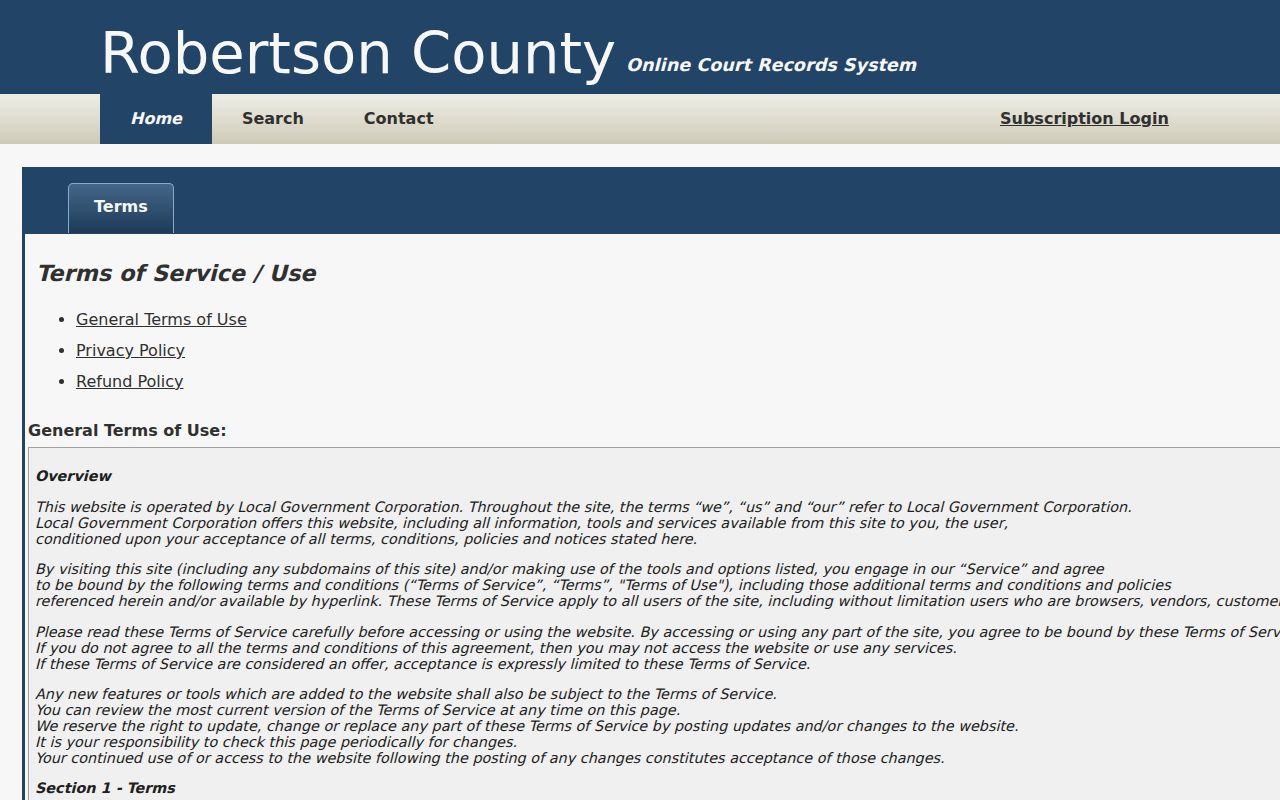
Those terms make the point plainly. A public result is a search lead, not the complete official criminal court record.
What a Criminal Docket Shows
Think of a Robertson County criminal docket as a chronology. It is not a single verdict line. Begin with the court, case number, case year, filing date, judge, and status. Then work through the party roles and charge block. Move on to settings, case-history entries, judgment, costs, and any appeal reference. The county publishes no complete disposition-code list. So when an abbreviation stumps you, check it against the clerk's wording and the signed order.
| Case Number | Court identifier and final numeric search segment, such as 12345. |
|---|---|
| Charge | Offense wording, statute, and classification shown in the court file. |
| Settings | Date, time, room, judge, and hearing type for each listed event. |
| Bond and Plea | Release security, forfeiture entries, and any plea recorded by the court. |
| Disposition | Judgment, dismissal, sentence, costs, and appeal entries, subject to clerk confirmation. |
Robertson County Criminal Docket Outcomes
A name on the Robertson County criminal docket proves nothing by itself. It could be a pending charge or a citation. It could be a dismissed case, or a record whose outcome needs clarification. The county warns that its portal is not the complete official court record. It also warns the portal is not for legal purposes. Read any status label beside the dated case-history entries.
Outcome check: Request the judgment, sentencing order, clerk-certified docket, or certified disposition when the exact result matters. A search-result printout is not automatically certified.
Tennessee Rule of Evidence 902 explains a simple point. A public record certified by its custodian can authenticate itself. For Circuit/Criminal and General Sessions material, the Circuit Court Clerk is the right route. A signed record also settles confusion when the public result uses shorthand nobody has defined.
The public Robertson search offers no document-image tab, export control, update timestamp, or bulk-download tool. Those features may change, so ask the office what exists today. A result may list an indictment, motion, or judgment with no viewable image. Then give the clerk the exact case number, filing date, and document name. Ask whether inspection is available. Ask too whether the office can send a plain or certified copy.
Stages on a Criminal Docket
A Robertson County criminal docket can open with a complaint, warrant, citation, indictment, or information. An initial appearance or arraignment may record rights, plea, and bond. Motion and pretrial settings follow while the parties prepare. Later entries can show a plea or trial. They may also show judgment, sentence, costs, and appeal notice. A bond-forfeiture entry flags an enforcement issue. It is not the final result of the charge.
Docket flow: Filing › Arraignment › Pretrial › Plea or Trial › Disposition › Sentencing
Dates shift. A continuance or reset merely moves a setting, and a dismissal ends a charge only as the written order says. Confirm the live date with the clerk.
Older Robertson County Criminal Dockets
Older criminal files live outside the modern portal. Robertson County Archives holds records spanning 1796 through 2021. Its indexed Criminal Court loose papers run from 1900 through 2013, and General Sessions material runs from 1947 through 1994. The indexes are works in progress that change daily. An archive hit is a pointer, not proof that the full Robertson County criminal docket survives.
Use the guest Archives search with a partial surname when spelling may vary. Record the index name, date range, case or volume reference, record group, and any image identifier. Then ask Archives to locate the underlying file and quote the delivery cost. Certified historical copies are not scanned or emailed. Plan on pickup or postal delivery.
Which Court Holds Criminal Dockets
Felony cases run through Circuit/Criminal Court. Kristy Chowning's Circuit Court Clerk office is the local access point. General Sessions takes misdemeanor criminal matters plus Robertson County and Tennessee Highway Patrol traffic citations. Both offices appear in TNCRTInfo. The criminal checkbox alone will not sort them out. Pick the office that matches the offense and the issuing paper.
Municipal ordinance and city traffic cases belong to the right City Court Clerk. The portal offers no Court Type checkbox for them. Juvenile cases take a separate route with tighter access limits. The Tennessee Public Case History system covers public appellate matters only. It is not a statewide layer for Robertson trial dockets. An empty county search may call for a municipal clerk, a Juvenile clerk, or an appellate search. It may not call for another broad name query.
Robertson sits in Tennessee's 19th Judicial District alongside Montgomery County. That structure merges nothing. Each county keeps its own clerk files. Use Robertson's clerk for the Robertson trial record. A notice of appeal then leads to the separate Tennessee appellate Public Case History system. Appellate results show milestones, parties, and record information. The trial clerk still holds the county judgment and the certified trial docket.
Robertson County Criminal Docket Clerks
Call the Circuit Court Clerk at 615-384-7864 for Circuit and Criminal matters. General Sessions uses 615-382-2324. The county courts sit at 422 West Court Square, Suite 106, Springfield, Tennessee 37172. An AOC clerk profile also lists 501 South Main Street, Room 109. Confirm the right room before you drive over. Regular county office hours run 8:00 a.m. to 4:30 p.m. on weekdays. Holidays are excepted.
Ask by name. Request an inspection, plain copy, certified docket, judgment, or disposition in those exact terms. The county public-records page opens Circuit Court and General Sessions records to inspection. That access holds during regular hours unless an exception applies. Copies and certification may carry fees. The clerk posts no per-page rates, so request a quote before ordering. Confirm mail, fax, or other delivery steps with the responsible office as well.
Leave the phone and watch in the car. The courthouse bans cell phones, electronic devices, and watches from courtrooms. Bring government identification and allow time for security. Call ahead about a public terminal. Ask what it shows. Some terminals carry only limited portal data, while others open up more public file material.
Robertson County Recovery Court Records
Tennessee's official behavioral-health court directory lists Robertson County Mental Health Court and Recovery Court contacts. A program name is not a case number. It never replaces the underlying criminal docket. Search the criminal court record first, then use the program contact only for the specialty-court procedure tied to that case.
Participation details can involve treatment or other sensitive facts. Those do not belong in a public summary. Record only what the clerk releases: the court, the setting, the order, and the disposition. An unclear specialty entry deserves a question. Ask whether the event sits on the ordinary criminal docket, a separate program calendar, or a restricted record.
Public Access and Sealed Criminal Dockets
Tennessee presumes court records open. The rule has exceptions. A Robertson County criminal docket may omit sealed or expunged material, redact private identifiers, or show only a limited marker. Juvenile files get special statutory protection. An absent result can also mean the wrong court, the wrong year, municipal routing, or an indexing gap, so absence alone tells you nothing.
Key access rules:
Tennessee Supreme Court Rule 34 opens court public records unless a law or rule expressly excepts them.
T.C.A. §37-1-153 guidance describes the limited access framework for juvenile files and records.
Tennessee Rule 1A materials describe the serious-interest test for sealing court records.
Start with a phone call or visit to the clerk's office in Robertson County. Ask plainly: is this criminal docket public, restricted, sealed, or expunged? The clerk can also tell you whether a redacted docket entry exists. If the open record looks thin, ask for something else. A public judgment or a limited entry may be supplied instead. Do not chase hidden content through some other portal.
When you make the request, be specific. Name the court, the case year, the public case number, and the exact item you want. Tennessee guidance lets an office decline to build a new record. It may also decline to compile an answer that was never filed. So ask for a dated judgment or a specific docket entry. That works far better than asking the clerk to reach a legal conclusion.